Urumqi Fair
This was the website for the 1998 Urumqi Fair held in Xinjiang, China.
Content is from the site's 1998 archived page to be perused for historical purposes only , as wll as other sources.
~~~
Did you know:
Since 1992 the Urumqi Fair, formerly known as the Urumqi Foreign Economic Relations and Trade Fair, has been held annually. Its purpose is to promote trading and market exploration in Northwestern China with foreign countries located mainly in Central Asia. The last fair was held in 2010. The event is now known as the China-Eurasia Expo and has become the leading trade platform in the region, extending its trading reach beyond for Central and South Asia to the entire Asia and Europe.
When I was working for Archer Daniels Midland Company, the world's largest agricultural processor of soybeans, corn, wheat & cocoa, I attended several of the Urumqi Fairs including the 1998 show. But that was years ago. I am now working for an online casino affiliate that features a number of well respected online casinos. If you are into real money slots I suggest you check out Online-Casino-Party.co. I was surprised but I really enjoy playing slots online after working all day with clients. Sometimes I play with real money, and other times when I want to check out a new slot game I will just play the free version with "free" cash. Boy is it fun to make crazy bets knowing you won't lose and money. Of course if you win big on a free game you can't collect your money either.
I admit I flailed around for awhile after I left Archer Daniels Midland Company, but I now recognize that being involved in the designing and maintaining websites is really my passion. Sometimes the road to your true calling takes you the long way around. But I have finally arrived.

Invitation
If you are interested in Urumqi Fair, You should get an invitation to the fair for your visa and Visitor ID card, which an be gotten from the following organizations prior to Aug. 15th: Urumqi Fair Office of Xinjiang Department of Foreign Trade and Economic Cooperation(DOFTEC); Add: 11 Tuanjie Road, Urumqi, Xinjiang, 830001, P.R.China. Tel: 86-991-2879890, 2850497 Fax: 2879890, 2860255. E-mail:urumfair@mail.wl.xj.cn . Xinjiang's enterprises with which you have business relations; The Economic and Commercial Counsellor's Office of the Embassy of P.R.C.in Russia, Kazakhstan, Kirghizstan, Tadzhikistan, Uzbekistan, Turkmenistan,and Pakistan.


| If you have decided to visit Urumqi Fair,please fill in the following form and send it to us. we will list your details into Foreign visitors Directory.
Arriving at Urumqi, you're requested to proceed to the 2nd floor of Kunlun Hotel for visitor cards, for your convenience for admission and bussiness talks. For a visitor card, your passport and Invitation are required with a one-inch photo and a business card. |
Information for Participants
If you want stands for the exposition, please fill in the Application form and send it to the Urumqi Fair Office prior to July 30th,then the Office will grant you a Confirmation with which you will enjoy preferential treatment and get your visitor card free of charge.
Participant could join any organization for trade promotion, and are welcome to order stands directly from Urumqi Fair Office.10-20% discount or commission will be given to the organizer who orders more than 10 stands.
Preferential Treatment: According to preferential treatment of border trade, a tariff of 50% discount will be collected on a batch of exhibits, and a tariff-free on a small amount of exhibits no more than RMB 5000, except those commodities forbidden to import or administrated by quotas and licenses.
The exhibits will be inspected priorly at Chinese Ports, and are permitted to display and sell during Urumqi Fair without any inspection.
The equivalents of exhibits, cash or Chinese commodities are permitted to be taken away from China, except some kinds of goods forbidden to be exported.
Participants have a priority to go through entry and exit formalities, to book air and train tickets, holding the Invitation or the confirmation of stands.

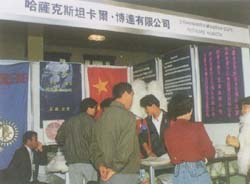
Stand and Price
|


International Exhibition Centre
|
|
|---|


China's Xinjiang Internation Exhibition Centre is under the Xinjiang Department of foreign Trade and Economic Cooperation. In the centre there is an exhibition department, an advertising company, an import and export corporation, a travel agency, a furniture company Ltd. and Commercial Company. The centre covers an area of 63,000 square metres. It has fourteen Exhibition halls with an exhibition area of 15,000 square metres. Besides this, there is an outdoor space of nearly 7,650 square metres. It is the sole ideal place for large - scale activities in Xinjiang, such as domestic and foreign exhibitions, economic and trade negotiations, trade fairs, etc. Since 1992, the centre has successfully run all the Previous Urumqi Foreign Economic Relations and trade Fairs. These events received favourable comments from businessmen at home and abroad. The centre has its feet firmly planted at home yet keeps the world in its view. It organizes and undertakes such activities as domestic and foreign exhibitions, commodities fairs, trade negotiations and scientific, technical and cultural exchanges. It can provide services for domestic and foreign businessmen in many ways, such as organizing exhibitions and meetings, trading, shopping, arranging tours, communications, transportation, advertising, printing, consultations, etc.
Add£ºNo.43 North Youhao Rd. Urumqi, China
Tel:(0991) 4844160 4823376
Fax:(0991) 4843753 4823349
P.C:830000

| Unit: Square metre |
| 101 hall | 102 hall | 103 hall | 104 hall | 105 hall | 106 hall | 107 hall | 108 hall | 301 hall |
|---|---|---|---|---|---|---|---|---|
| 512 | 871 | 635 | 871 | 512 | 1471 | 1300 | 1471 | 703 |
| 201 hall | 202 hall | 203 hall | 204 hall | 205 hall | 206 hall | 207 hall | 208 hall | |
| 512 | 871 | 430 | 871 | 512 | 440 | 1600 | 1600 |
A General Introduction to Xinjiang Uygur
 |
|
The Xinjiang Uygur Autonomous Region is located in the northerwestern part of China, in the hinterland of Eurasia.Covering an area of more than 1.66 million square kilometers, is the largest administrative division.Xinjiang is contiguous to the People's Republic of Mongolia,Russia, Kazhstan, Kirghizstan,Tadzhikistan, Afghanistan, Pakistan, India, with a boudary ine of more than 5,400 kilometers, the longest in China.Xinjiang has a typical continental climate, with sufficient sun- shine but little rainfall,It's yearly precipitation averages only 150 mm and des- parity of tempera ture in the whole region is above 12c. |
|

The total population of Xinjiang is over 16.89 million, among which the minority nationalities
are over 10 million, account for 62 of the total population, including Uygur, Hans, Kazarks, Huis,
Mongols, Kirghizes, tajiks, Uzbeks, Tatars, Manshus, Russians,etc. Most of the minority nationa-
lities believe in Islamism and this makes Xinjiang one of the main residential areas for Chinese
Moslems.
Under Xinjiang Autonomous Region are five autonomous prefecture, eight prefectures, 3 cities
under the direct jurisdiction of the region,85 cities at county level,11 regions under the direct jurisdi-
ction of city.Urumqi is the cipital city.
* Five Autonomous Prefecture: Ili Kazark Autonomous Prefecture,Bortala Mongol Autonomous
Prefecture, Changji Hui Autonomous Prefecture, Bayangol Mongol Autonomous Prefecture,
and Kizilsu Kirghiz Autonomous Prefecture
* Eitgt Prefecture: Turpon, Kumul(Hami), Aksu, Kashgar(Kashi) Hotan, Ili, Tarbagaty(Tachen),
and Altay
* Three Cities under the direct jurisdiction of the region: Urumqi, Karamay,Shihezi

More Background On UrumqiFair.com
UrumqiFair.com is an archival website preserving information from the 1998 Urumqi Foreign Economic Relations and Trade Fair, an annual international trade event held in Urumqi, Xinjiang, China. Although no longer an active commercial portal, the website functions as a historical record of a significant regional trade platform that operated from 1992 through 2010.
The fair itself played a strategic role in linking Northwestern China with Central Asia and, eventually, broader Eurasian markets. Today, its legacy continues through the China-Eurasia Expo, but UrumqiFair.com captures the fair during a pivotal phase when Xinjiang was positioning itself as China’s western gateway to emerging post-Soviet economies.
This article provides a comprehensive overview of the website, the fair it documented, its ownership and institutional structure, its economic and geopolitical significance, the exhibition center, participant logistics, pricing structures, audience demographics, press coverage, cultural implications, and long-term legacy.
Historical Context: The Birth of the Urumqi Fair
The Urumqi Foreign Economic Relations and Trade Fair was established in 1992. Its founding coincided with two major developments:
- China’s deepening economic reforms following Deng Xiaoping’s Southern Tour.
- The collapse of the Soviet Union in 1991, which opened newly independent Central Asian markets.
Xinjiang shares borders with eight countries: Mongolia, Russia, Kazakhstan, Kyrgyzstan, Tajikistan, Afghanistan, Pakistan, and India. This 5,400-kilometer frontier made the region uniquely positioned for cross-border trade. Urumqi, the capital of Xinjiang, became the logical hub for facilitating these new economic relationships.
The fair’s primary purpose was to promote trade and market exploration in Northwestern China and to strengthen commercial ties with neighboring Central Asian countries. Over time, its scope expanded to include South Asia, parts of Europe, and broader Eurasian economic engagement.
The last Urumqi Fair was held in 2010. Beginning in 2011, the event was upgraded and rebranded as the China-Eurasia Expo, reflecting China’s broader geopolitical and economic ambitions across Asia and Europe.
Geographic Significance of Urumqi and Xinjiang
Urumqi is the largest city in western China and serves as the political, economic, and transportation center of the Xinjiang Uygur Autonomous Region. The region covers approximately 1.66 million square kilometers, making it China’s largest provincial-level administrative division.
Xinjiang occupies a strategic position in the heart of Eurasia. Historically, it was a critical segment of the ancient Silk Road, facilitating the exchange of goods, cultures, and religions between East and West.
By the 1990s, China recognized Xinjiang’s potential as a modern trade corridor linking Chinese manufacturing centers with Central Asian markets. The Urumqi Fair became an institutional mechanism for operationalizing that vision.
Ownership and Institutional Backing
The Urumqi Fair was organized under the authority of the Xinjiang Department of Foreign Trade and Economic Cooperation (DOFTEC). The fair’s operational venue was the Xinjiang International Exhibition Center (XIEC), an entity directly affiliated with the regional government’s trade authorities.
The exhibition center was more than a simple event hall. It functioned as a multi-service institution with:
- An exhibition department
- An advertising company
- An import and export corporation
- A travel agency
- A furniture company
- Commercial services
This structure demonstrates that the fair was not merely a private enterprise but a government-supported trade initiative aimed at regional development and international integration.
Xinjiang International Exhibition Center (XIEC)
The Xinjiang International Exhibition Center served as the fair’s primary venue. Located on North Youhao Road in Urumqi, the center was designed to accommodate large-scale domestic and international exhibitions.
Key specifications included:
- Total area: 63,000 square meters
- Exhibition area: 15,000 square meters
- Fourteen indoor exhibition halls
- Approximately 7,650 square meters of outdoor exhibition space
- 3,000 square meters designated for large equipment demonstrations
The center provided comprehensive services including exhibition organization, trade negotiations, advertising, printing, transportation coordination, communications support, tourism arrangements, and business consultations.
By positioning the exhibition center as an all-in-one trade facilitation platform, the organizers minimized logistical barriers for international participants.
Structure of the Fair: Exhibitors and Participants
The archived structure of the fair reveals a highly organized commercial model designed to attract foreign and domestic exhibitors.
Stand Types and Pricing
Indoor standard stand (3m x 3m):
- USD $1,000 for eight days
- Approximately USD $111 per square meter
- Included three panel walls, a table, three chairs, fluorescent lighting, wastebasket, electrical socket, and bilingual fascia panel
Outdoor standard stand:
- USD $70 per square meter
- Included table, chairs, and canvas roof
Open demonstration space:
- USD $25 per square meter
- Intended for large-scale equipment displays
Participants also paid USD $50 for inclusion in the fair directory and online listing.
Discount incentives included:
- 10–20% commission or discount for organizers booking more than 10 stands
- 50% tariff discount on a batch of exhibits under border trade preferential policies
- Tariff-free status on small exhibit batches under RMB 5,000 (subject to restrictions)
These incentives illustrate how the fair actively encouraged international participation and cross-border commercial exchange.
Visitor Logistics and Visa Facilitation
One of the most striking features of the Urumqi Fair was its structured visa and invitation process.
Foreign visitors were required to obtain an official invitation from:
- The Urumqi Fair Office
- Xinjiang enterprises with business relationships
- Chinese embassy commercial offices in Central Asian countries
Upon arrival in Urumqi, visitors were directed to the Kunlun Hotel for registration and visitor card issuance. Required documentation included:
- Passport
- Invitation letter
- One-inch photo
- Business card
Participants holding official confirmation documents received preferential treatment for:
- Entry and exit formalities
- Air and train ticket bookings
- On-site admission
This structured approach underscored the fair’s emphasis on formal international trade rather than casual tourism.
Industries and Trade Focus
The fair’s core industries reflected both Xinjiang’s regional strengths and Central Asia’s economic needs. These included:
- Agricultural products
- Grain and soybean processing
- Machinery and equipment
- Light industrial goods
- Textiles
- Building materials
- Energy and mineral resource equipment
During the 1990s and 2000s, Central Asian economies were undergoing post-Soviet restructuring. Chinese exporters found significant opportunities in supplying machinery, consumer goods, and infrastructure materials.
At the same time, Xinjiang’s agricultural and resource sectors benefited from export access to neighboring countries.
Popularity and International Reach
Throughout its run from 1992 to 2010, the Urumqi Fair attracted:
- Thousands of domestic Chinese exhibitors
- Delegations from Central Asian republics
- Traders from Russia
- Representatives from South Asia
By the early 2000s, the fair was recognized as one of Western China’s most important trade platforms.
While exact attendance numbers varied year by year, media coverage during the 2000s described growing participation and increasing transaction volumes. The event became a fixture in regional trade calendars, particularly for businesses engaged in cross-border commerce.
Transition to the China-Eurasia Expo
In 2011, the Urumqi Fair was transformed into the China-Eurasia Expo. This shift represented more than a rebranding. It reflected China’s broader geopolitical strategy of integrating Eurasian economies through infrastructure, trade, and diplomatic coordination.
The new expo expanded its scope beyond Central Asia to include:
- South Asia
- Eastern Europe
- Broader European markets
The upgrade also signaled greater central government involvement and alignment with large-scale regional development strategies that would later be associated with the Belt and Road Initiative.
Cultural and Social Significance
Xinjiang is ethnically and culturally diverse, with significant populations of Uyghur, Han Chinese, Kazakh, Hui, Kyrgyz, Tajik, Uzbek, and other groups. Most minority populations in the region practice Islam.
The fair therefore functioned not only as an economic platform but also as a cultural meeting point. International delegations interacted with local enterprises in a region historically shaped by Silk Road exchanges.
Hosting a major international trade fair in Urumqi symbolized China’s commitment to integrating its western frontier into global economic systems.
Proximity to Key Infrastructure
Urumqi’s transportation network enhanced the fair’s viability:
- Urumqi Diwopu International Airport connected the city to major Chinese and regional destinations.
- Rail links connected Urumqi to Lanzhou and eastern Chinese industrial centers.
- Highway networks facilitated cross-border trucking to Kazakhstan and beyond.
These infrastructure assets supported the fair’s commercial ambitions.
Media Coverage and Press Attention
Regional Chinese media frequently covered the fair’s opening ceremonies, trade agreements, and foreign delegations. Over time, coverage expanded as the fair gained prominence.
As it transitioned into the China-Eurasia Expo, international press attention increased, particularly in discussions of China’s westward economic expansion and Eurasian connectivity strategies.
Audience Profile
The fair primarily attracted:
- Trade delegations
- Import/export companies
- Agricultural processors
- Machinery manufacturers
- Government officials
- Economic development agencies
Unlike consumer expos, the Urumqi Fair was business-oriented and focused on trade contracts and negotiations rather than retail sales.
Long-Term Legacy
The legacy of the Urumqi Fair is significant in several respects:
- It institutionalized cross-border trade between China and Central Asia.
- It elevated Xinjiang’s role in China’s international economic strategy.
- It laid the foundation for the China-Eurasia Expo.
- It demonstrated the viability of large-scale trade events in Western China.
By the time of its final edition in 2010, the fair had operated for nearly two decades, serving as a bridge between China’s industrial base and the markets of Central Asia.
UrumqiFair.com as a Historical Artifact
Today, UrumqiFair.com stands as a preserved digital record of a pivotal moment in regional trade history. The site’s structured descriptions of stand pricing, visa requirements, exhibition hall specifications, and tariff policies provide rare insight into how China managed international trade events during the 1990s.
Although static and archival in nature, the website reflects a broader story: the transformation of Xinjiang from a peripheral frontier into a strategic node in Eurasian commerce.
UrumqiFair.com documents more than a single trade event. It captures a formative period in China’s westward economic expansion and the institutional mechanisms used to cultivate cross-border trade in the post-Soviet era.
From its founding in 1992 to its transformation in 2011, the Urumqi Fair helped redefine Xinjiang’s role in international commerce. The exhibition center, government backing, tariff incentives, structured visa processes, and regional connectivity all contributed to its success.
Today, while the China-Eurasia Expo continues the mission on a larger scale, UrumqiFair.com remains an important historical reference point — a digital window into the early architecture of Eurasian trade integration.